Safety doesn’t start with policy—it starts with conversation. And nowhere is that more critical than in the brief, focused exchanges known as toolbox talks. These short, informal safety meetings are where real change happens: where workers connect with risks, supervisors reinforce protocols, and teams align on safe practices. But without strong, relevant content, toolbox talks become routine, forgettable, and ineffective.
The key? Practical, relatable examples. Generic warnings about "staying safe" don’t stick. What does? A 10-minute discussion on how a misplaced extension cord caused a fall last week. Or a walkthrough of how improper ladder setup led to a strain—using photos from your own site. That’s what drives behavior change.
Below are real, actionable toolbox talk examples used across industries—construction, manufacturing, utilities, and field services—designed to spark engagement, clarify risks, and build a culture where safety is spoken, not just posted.
Why Most Toolbox Talks Fail (And How
These Examples Fix That)
Too many toolbox talks follow the same flat script: “Wear your PPE,” “Watch your step,” “Report hazards.” These statements aren’t wrong—but they’re vague, predictable, and easily ignored. Workers tune out because the message lacks context, urgency, and relevance.
Effective toolbox talks do three things differently:
- They’re hazard-specific – not general.
- They use real situations – not hypotheticals.
- They invite interaction – not just listening.
For example, instead of saying “Use fall protection,” try: “Last Tuesday, a worker on Site B was found working on a roof without harness attachment—just a lanyard clipped to his belt. What could go wrong in 10 seconds? Let’s talk.”
That version creates tension, triggers memory, and opens dialogue. That’s the power of a strong toolbox talk example.
Construction: Working at Height – Ladder Safety
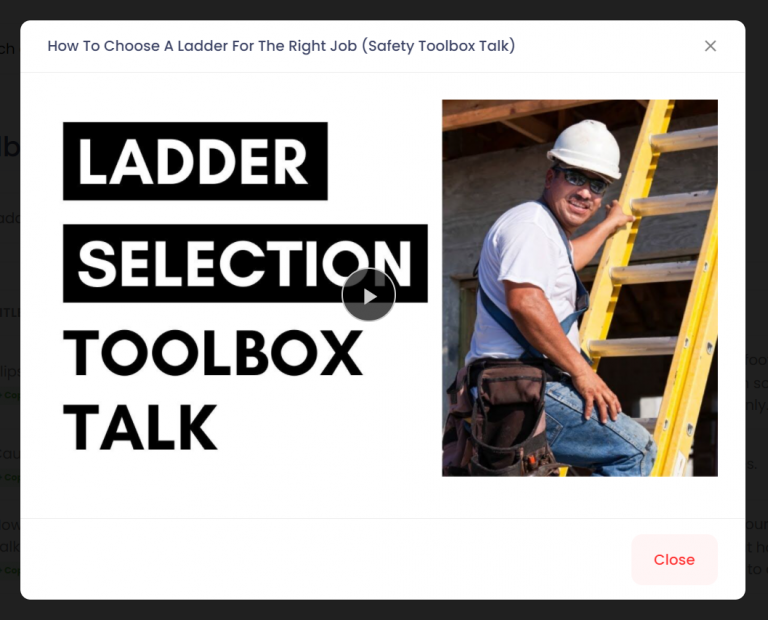
Working from ladders is one of the most common—and often most dangerous—tasks on job sites. A slight overreach, improper setup, or worn rung can lead to serious injury.
Toolbox Talk Script Example:
“We’ve all used extension ladders, but how many of us check the feet before climbing? Two weeks ago, a frayed rubber foot on a ladder at Site 3 caused a slip. The worker caught himself—but it was close. > Today’s 5-minute talk: ladder safety. > - Always inspect the ladder before use—look for cracks, loose rungs, damaged feet. - Set on level ground. Use stabilizers or levelers if needed. - The 4-to-1 rule: for every 4 feet of height, move the base 1 foot out. - Maintain three points of contact—two hands and one foot, or two feet and one hand. - Never lean or overreach—reposition the ladder instead. > Anyone had a close call with a ladder? Let’s hear it.”
Why It Works: It references a real incident, uses clear visuals (4-to-1 rule), and encourages peer stories—proven to increase retention and engagement.
Manufacturing: Lockout/Tagout (LOTO) Procedures
In facilities with heavy machinery, LOTO is non-negotiable. Yet, lapses happen—often due to time pressure or complacency.
Toolbox Talk Example:
“Last month, a maintenance tech bypassed a lockout because ‘it would only take a minute’ to clear a jam. The machine cycled unexpectedly. He wasn’t seriously hurt—but it could’ve been worse. > Today: Why lockout isn’t optional. > - Energy sources (electrical, hydraulic, pneumatic) must be isolated. - Only the person who applied the lock can remove it. - Test the machine after lockout to confirm zero energy. - Never use someone else’s lock or share keys. > Quick scenario: You’re helping a colleague clear a jam. The power is off, but no lock is in place. What do you do? > Answer: Stop. Lock it out. Tag it. Then assist.”
This approach turns compliance into a shared responsibility. It also uses a “what would you do?” prompt, which boosts engagement and decision-making.
Field Services: Slips, Trips, and Falls on Wet Surfaces
Technicians in utilities, telecom, or HVAC often work in unpredictable environments—rain-soaked rooftops, icy driveways, muddy trenches. Slips, trips, and falls account for over 20% of workplace injuries.
Toolbox Talk Example:
“Last week, a technician slipped on algae-covered steps at a residential site. Minor sprain, but downtime and a near-miss report. > Today: How to stay on your feet—literally. > - Look down. Scan walking paths for debris, water, ice, or uneven surfaces. - Use slip-resistant footwear—check soles regularly for wear. - Clear walkways before starting work. Use mats or signage if needed. - Carry tools in a bag—don’t juggle them while walking. > Pro tip: Take the ‘three-second scan’ every time you enter a new area. What’s the first hazard you see?”
By focusing on small, repeatable habits—like the “three-second scan”—this talk builds awareness that lasts beyond the meeting.
Electrical Safety: Working Near Overhead Power Lines
Overhead lines are silent killers. Contact with high-voltage wires causes dozens of fatalities annually—often in non-electrical roles like crane operation or tree trimming.
Toolbox Talk Example:
“In 2023, a crane operator in Ohio didn’t account for a 13,800-volt line. Boom made contact. Equipment was destroyed, operator hospitalized. > Reminder: Always assume power lines are live. > - Maintain at least 10 feet of clearance for lines under 50kV. - Use a spotter when operating tall equipment near lines. - Call 811 before digging—underground lines are a risk too. - If contact occurs, stay in the cab and call for help. > Question: What would you do if your ladder is about to touch a line? > Answer: Stop. Move it slowly and deliberately—never jerk or rush.”
This example uses a real-world consequence and emphasizes the “what would you do?” approach, which sharpens situational judgment.
Driving Safety for Mobile Workforces
Many workers spend hours driving between sites. Yet, vehicle safety is often overlooked in toolbox talks.
Toolbox Talk Example:
“Our team logged over 1,200 driving hours last month. One near-miss from distracted driving—a driver texting at a red light. > Let’s talk about staying alert behind the wheel. > - No texting, ever. Use hands-free only for essential calls. - Plan routes in advance—don’t navigate while moving. - Take a break every 2 hours on long drives. - Check mirrors and blind spots—especially when reversing. > Challenge: Try the ‘no phone’ rule for one week. Track how it feels. We’ll check in next meeting.”
This talk sets a behavioral goal—making safety personal and measurable.
Seasonal Talks: Heat Stress in Summer
Heat-related illness is preventable—but it’s a leading cause of summer downtime.
Toolbox Talk Example:
“It hit 94°F yesterday with high humidity. Two workers reported dizziness by noon. > Heat stress kills. Know the signs: - Heavy sweating → then sudden stop (danger sign) - Headache, nausea, cramps - Confusion or dizziness > Prevention: - Drink water every 15–20 minutes—even if not thirsty. - Wear light, breathable clothing. - Take breaks in shade or cool areas. - Use the buddy system—watch each other. > Remember: Thirst means you’re already dehydrated.”
This talk is timely, urgent, and gives clear thresholds for action.
How to Deliver Toolbox Talks That Stick
Even the best example fails if delivered poorly. Follow these editorial-tested tips:
- Keep it short: 5–10 minutes max.
- Use visuals: Show photos of hazards or proper PPE.
- Invite input: Ask “What would you do?” or “Has this happened to you?”
- Rotate facilitators: Let crew leads or experienced workers run a session.
- Document it: Sign sheets aren’t just compliance—they show commitment.
- Follow up: If a hazard is raised, act on it and report back.
Also, avoid common mistakes: - Reading from a script word-for-word. - Ignoring worker questions or concerns. - Holding talks in loud, distracting environments. - Skipping them during busy periods.
Consistency beats perfection. A simple, sincere talk every week does more than a flawless one every month.
Closing: Make Safety a Conversation, Not a Lecture
Toolbox talks shouldn’t be a box to check. They’re a pulse check on your team’s awareness and habits. The best ones don’t just inform—they connect, challenge, and change behavior.
Use these toolbox talk examples as templates, then adapt them. Insert your site’s incidents, your team’s language, your real near-misses. That authenticity turns routine meetings into moments that matter.
Start tomorrow: pick one topic, gather your crew, and talk. Not to them—with them. That’s how safety becomes culture.
Frequently Asked Questions
What are the most common topics for toolbox talks? Fall protection, PPE use, electrical safety, hazardous materials, equipment operation, and emergency response are among the most common and critical topics.
How long should a toolbox talk last? Aim for 5 to 10 minutes. The goal is focused, actionable discussion—not a lengthy training session.
Who should lead a toolbox talk? Supervisors typically lead, but experienced crew members or safety officers can also facilitate. Rotating leaders increases engagement.
Do toolbox talks need to be documented? Yes. Sign-in sheets or digital logs demonstrate compliance and help track attendance and topics covered.
Can toolbox talks reduce workplace incidents? Yes. Regular, relevant talks improve hazard awareness, reinforce procedures, and encourage peer accountability—key drivers in reducing accidents.
Should toolbox talks be the same every week? No. Rotate topics based on current risks, season, project phase, or recent incidents. Revisit critical topics quarterly.
How often should toolbox talks be held? Weekly is ideal. Daily may be necessary on high-risk sites. Monthly is the minimum for most operations.
FAQ
What should you look for in Practical Toolbox Talk Examples for Safer Workplaces? Focus on relevance, practical value, and how well the solution matches real user intent.
Is Practical Toolbox Talk Examples for Safer Workplaces suitable for beginners? That depends on the workflow, but a clear step-by-step approach usually makes it easier to start.
How do you compare options around Practical Toolbox Talk Examples for Safer Workplaces? Compare features, trust signals, limitations, pricing, and ease of implementation.
What mistakes should you avoid? Avoid generic choices, weak validation, and decisions based only on marketing claims.
What is the next best step? Shortlist the most relevant options, validate them quickly, and refine from real-world results.